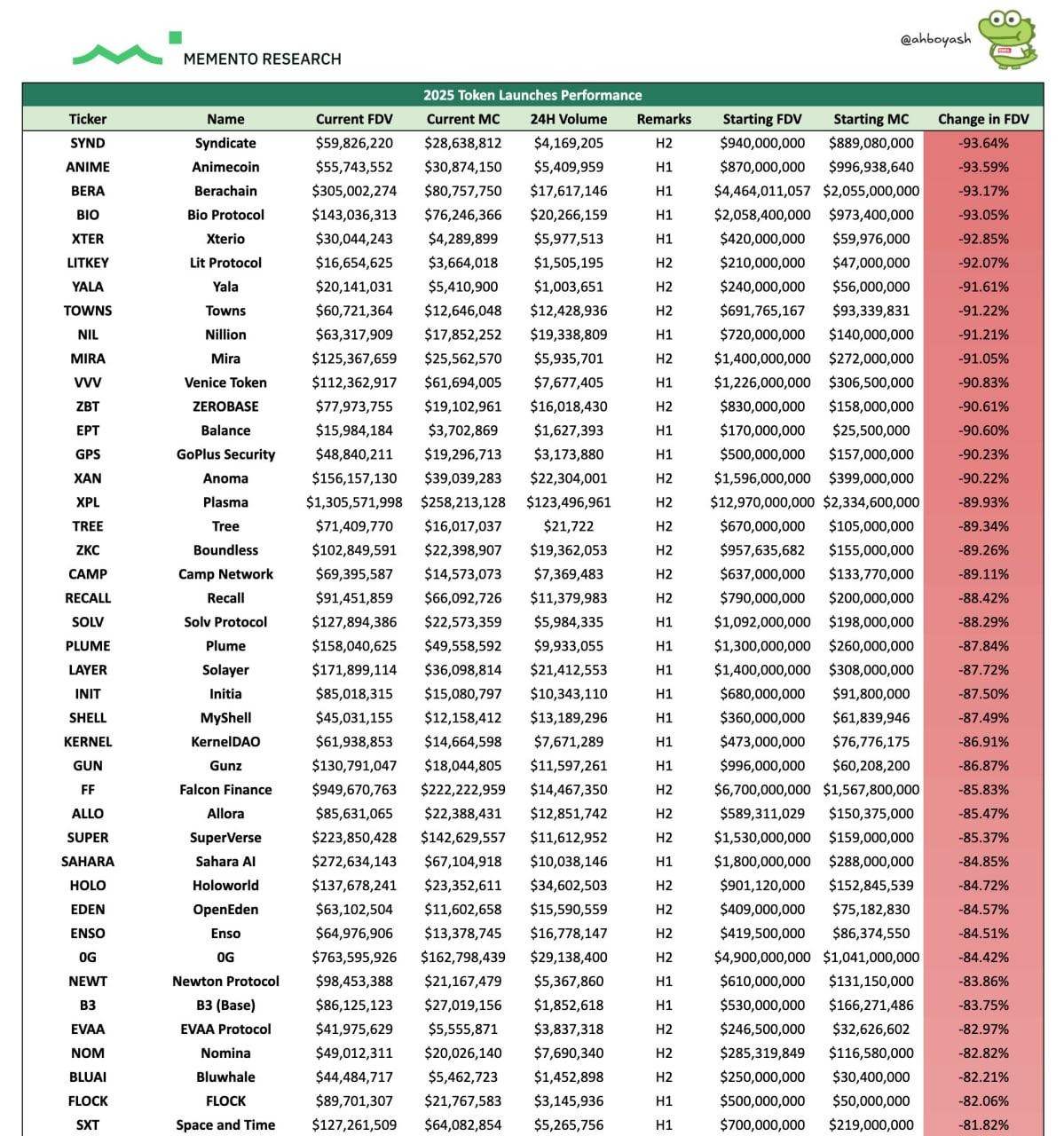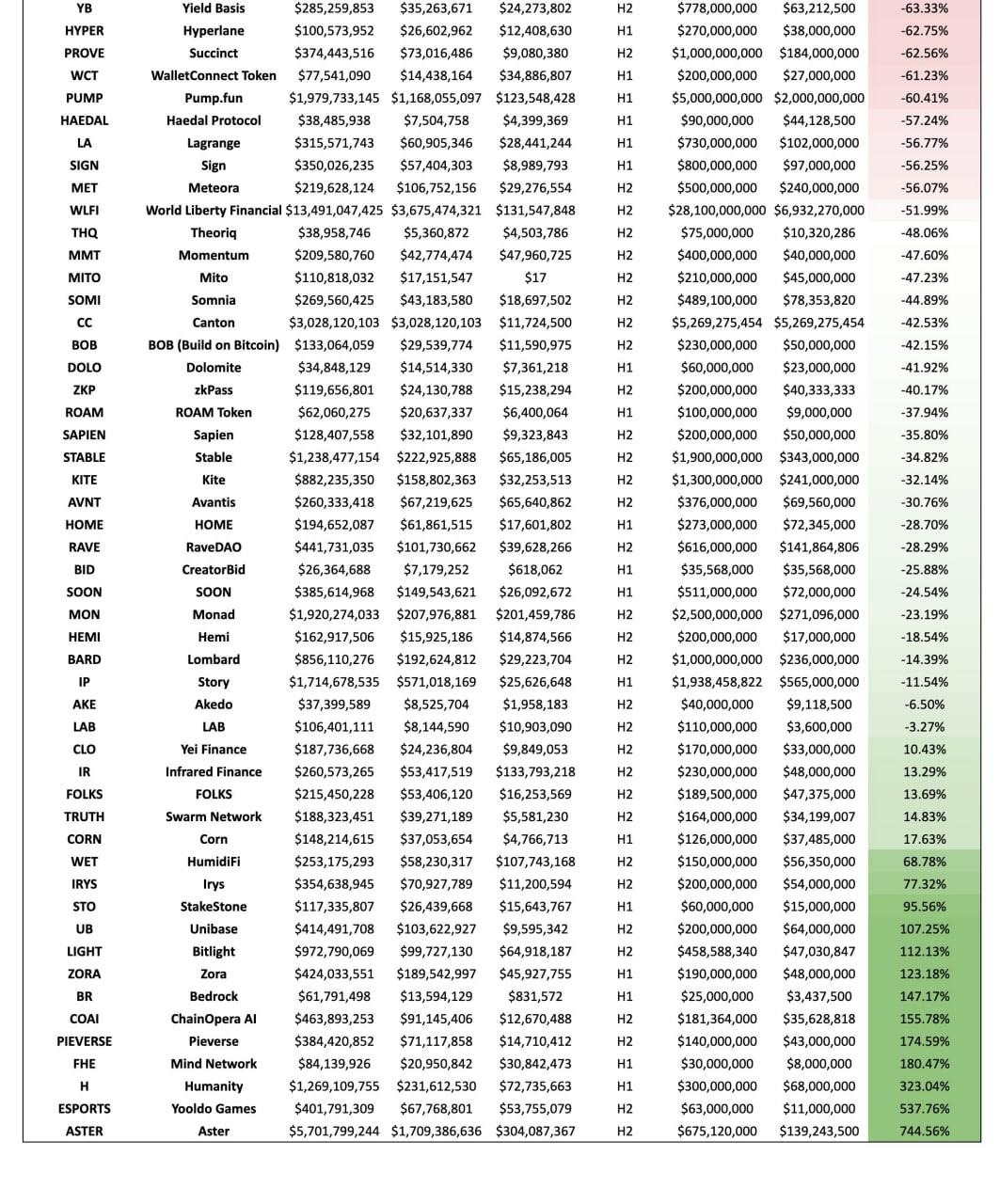
In a year where most token launches failed, the survivors shared one thing in common: real fundamentals.
In 2025, 84.7% of token launches ended up below their opening price. The median loss was 71%. According to Memento Research, the projects that struggled shared one thing in common: they went to market before their foundations were ready.
The lesson is clear. Sustainable value isn't created at launch. It's created long before.
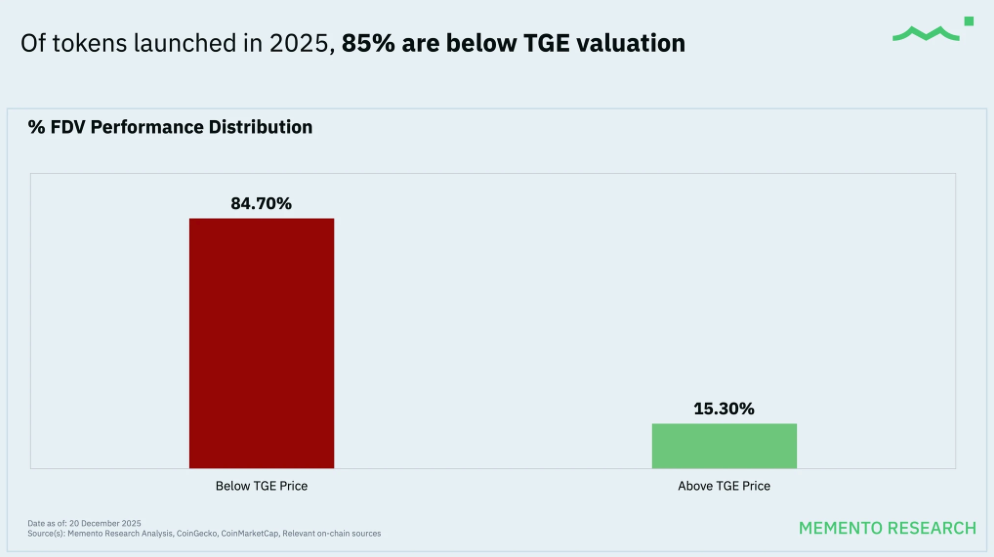
The 2025 TGE Landscape
The data tells a stark story.
CoinGecko's analysis reveals that more than half of all crypto tokens launched since 2021 are now defunct - and 86% of those failures happened in 2025 alone. While much of that volume came from low-effort memecoins, even well-funded projects with serious backing struggled to hold value.
Memento Research tracked 118 major token generation events this year. 100 of them are now underwater. The patterns behind these outcomes were remarkably consistent:
Inflated valuations without real demand. Projects launched at billion-dollar fully diluted valuations backed by pitch decks and promises. Among the 28 tokens that debuted at $1 billion FDV or higher, not a single one is trading above its launch price today. Zero.
The "low float, high FDV" model reached its limit. Retail investors bought into circulating supplies of 10-15%, while insiders held the remaining 85% on vesting schedules. When unlocks arrived, prices collapsed. This structure, once considered sophisticated tokenomics, has proven unsustainable.
Mercenary liquidity replaced genuine investment. Capital flowed in for launches and flowed out within days. The focus was extraction, not construction.
"I don't know a single liquid fund that has bought a new token on TGE in over two years. That should probably tell you something."— Jeff Dorman, Chief Investment Officer, Arca
When institutional buyers stop showing up, retail participants absorb the selling pressure alone.
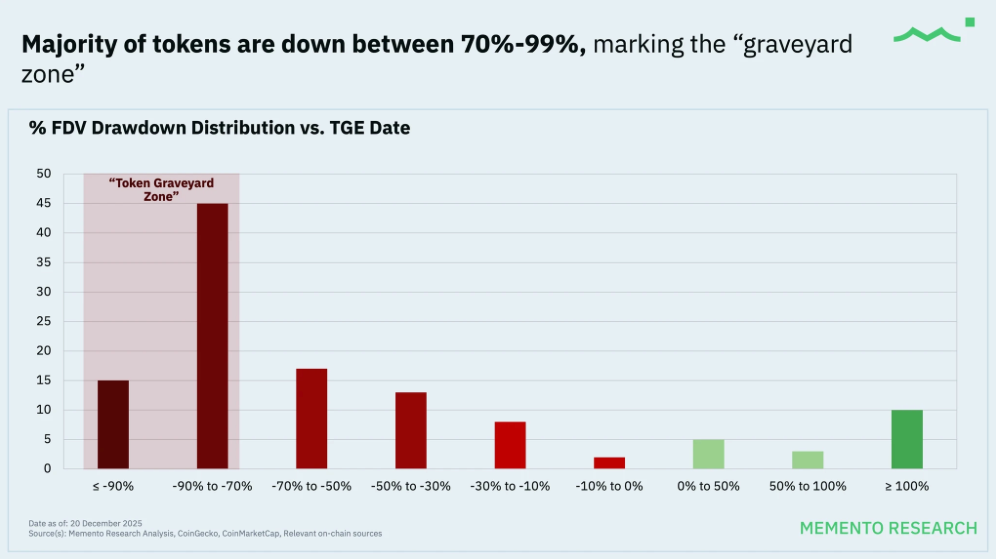
The Bigger the Launch, the Harder the Fall
There's a reason the most anticipated projects produced the steepest losses.
Memento Research found that when you weight performance by FDV, the average 2025 token is down 61.5% from launch — nearly double the equal-weighted average. The more hyped the token, the worse it performed.
This isn't speculation. It's arithmetic.
Take Plasma, which launched at nearly $13 billion FDV and collapsed to $1.3 billion. Berachain, one of the most anticipated Layer 1 projects of the year, dropped 93% - from $4.46 billion to $305 million. Project after project followed the same trajectory: massive launch, immediate dump, months of bleeding.
The market delivered a clear verdict. It will no longer reward tokens that exist primarily as fundraising mechanisms.
What Actually Sustains Value
So what separates the survivors from the wreckage?
The answer is deceptively simple: revenue.
In DeFi, that revenue comes from liquidity and usage. Protocols with real fees and real income generate real value. Everything else is noise.
The numbers bear this out. Total value locked across DeFi reached $123.6 billion in 2025, up 41% year-over-year. But that capital isn't distributed evenly. It concentrates in protocols that actually work.
According to Token Terminal and DeFiLlama data, the leading protocols share common characteristics:
- Aave holds $42.4 billion in TVL, generates $96 million in monthly fees, with $13.2 million flowing to the protocol as retained revenue.
- Lido anchors $38.3 billion in staked ETH, serving as foundational infrastructure for Ethereum's security.
- Jupiter leads fee generation with $101 million in 30-day fees and $24.6 million in retained revenue, establishing itself as Solana's default aggregator.
These aren't meme projects riding narrative cycles. They're businesses generating income.
The pattern is unmistakable. The protocols with the highest fee generation are the ones with the strongest long-term token performance. Revenue isn't a nice-to-have. Over time, it's the only thing that matters.
The Path Forward
The wreckage of 2025 provides a clear roadmap for what comes next.
Memento Research analyst Ash Liew advises treating token launches like earnings reports, not lottery tickets. Sophisticated participants are now demanding proof before participation: mapped unlock schedules, verified market-maker depth, and identifiable catalysts tied to real milestones.
The 15% of tokens that survived 2025 share common traits: transparent teams, clear compliance efforts, and a focus on solving specific problems — particularly in areas like Real World Assets (RWA) and decentralised infrastructure.
The market is evolving. The era of the governance token that does nothing but vote on forum posts is ending. What's emerging in its place is a clearer standard: tokens must be tied to businesses that generate value.
The Bottom Line
2025 was a year of reckoning. It separated projects built on hype from those built on fundamentals.
The lesson for builders is straightforward: revenue sustains what hype cannot. The projects that will define the next cycle are the ones laying foundations now - not racing to launch before they're ready.
For investors, the calculus has shifted. The question is no longer "how early can I get in?" It's "what is this protocol actually building, and does it generate real income?"
The answers to those questions will determine who thrives in what comes next.